Supply Chain Resilience & Vendor Risk Matrix 2026: How SMBs Can Eliminate Single‑Source Bottlenecks and Protect Working Capital
Learn how small and mid-sized businesses can build a vendor risk matrix to eliminate single-source bottlenecks, optimize safety stock, and protect working capital from supply chain disruptions.


Let’s start with a common misconception: when something goes wrong with a supplier, it’s not just a vendor problem—it’s a cash flow problem waiting to surface. Imagine your key supplier fails. Suddenly, you’re facing higher freight charges to rush in replacements, or you’re stuck with excess inventory you had to order in a panic. For small and mid-sized businesses, that’s a dangerous position. That’s where a vendor risk matrix comes in handy. By evaluating suppliers based on criticality, lead time, financial stability, and geographic exposure, you get a clear view of where single-source bottlenecks are hiding—before you’re backed into an expensive, last-minute scramble.
You might wonder just how costly supply chain disruptions can get. Well, according to a study by J.S. Held (as cited by NetSuite), the bill is expected to reach a staggering $184 billion per year by 2025. Big corporations tend to weather these storms by diversifying their suppliers or keeping large inventory buffers. But if you’re a small or mid-sized business, those tactics aren’t often realistic. The good news? There’s a disciplined, affordable way to spot your vulnerabilities early and calculate what it would take to fix them—long before a crisis puts you on the back foot.
So, how do you pull this off? It all starts with a vendor risk matrix—a straightforward, systematic way to assess your suppliers by criticality, reliability, and switching costs. With this approach, you’re not just chasing the lowest unit price; you’re making procurement choices that protect your margins and cash.
Key Takeaways
- By scoring your suppliers on criticality, lead time, and financial stability, you transform those hidden single-source risks into a clear, actionable priority list.
- What does this mean for you? It means you should adjust safety stock and reorder points for each SKU, rather than just increasing inventory across the board or shopping solely on price.
- And remember: resilience isn’t something you check off once a year. It’s about continuous monitoring, because supplier risk and freight conditions are going to keep changing throughout 2026—and beyond.
Build a Vendor Risk Matrix That Prioritizes Critical Exposure
Think of your vendor risk matrix as a tool for ranking suppliers by how much damage their failure could cause—not just by how much you spend with them. This shift in thinking helps you focus your qualification budget and management attention where it matters most.
Modern supply chain management doesn’t have to be complicated or expensive. The secret is to assess each supplier against practical criteria and roll those factors up into a single risk score. Remember, it’s the approach that counts—not the software. Sometimes, a well-kept spreadsheet beats an expensive tool that gathers dust.
Here’s how you can start scoring your suppliers:
- The importance of the component: identifying critical components helps determine whether a late input will stop operations or whether an alternative is available.
- A supplier that gives a lead time of 14 days but varies between 10 and 21 days under stress is riskier than one that remains at 30 days.
- Financial stability is in serious trouble when there are late payments, credit ratings are downgraded, or the supplier is at risk of going bankrupt before deliveries cease.
- Is there a concentration of multiple critical suppliers in a single country, port, or region?
- When looking at total cost of ownership (TCO), does the 'cheap' supplier still come out on top when you factor in freight, duties, and quality failure rates?
But don’t treat supplier risk assessment as a one-and-done task. Each time a certification expires, lead times shift, or new tariffs and export controls hit a supplier’s region, revisit those risk scores.
That’s why forward-thinking supply chain leaders make continuous monitoring a habit, regularly reassessing risks—including cybersecurity and operational conditions—across their entire partner network.
Here’s an insight that often surprises people: the real single-source risk can lurk several tiers upstream. Even with multiple qualified suppliers, they might all rely on the same upstream input. If you map only your direct suppliers, you could miss the real point of failure.
Once you’ve scored your suppliers, plot them on a simple grid: likelihood of disruption versus impact. The ones that land in the high-impact, high-likelihood zone? Those are your top candidates for backup sourcing—not your whole supplier list.
Replace Single-Source Dependencies With Qualified Backup Capacity
If you’re in manufacturing, you might think the answer to single-source dependency is finding five suppliers for every part. Not so! Instead, qualify at least one backup supplier for critical components that could halt your operations.
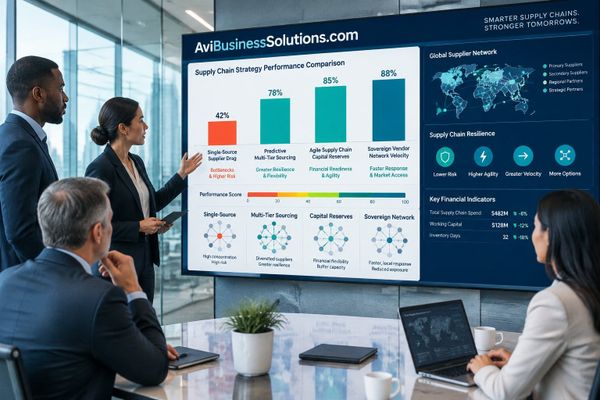
A layered approach works best: tie your multiple-sourcing strategy to your risk matrix rather than spreading it thin as a general policy. That way, you’re building a genuinely resilient supplier network—one that keeps unexpected bottlenecks at bay.
Treat your critical components and high-revenue parts differently from the everyday goods. Sure, splitting your orders might trim your economies of scale a bit, but the peace of mind and protection against disruption are usually worth it.
Apply diversification where it earns its cost:
- For the first level (critical, high-volume components), qualify at least two suppliers, preferably from different regions, to reduce concentration risk.
- For tier 2 (secondary components), select a secondary supplier and obtain an annual quote, even if you never place an order.
- For Tier 3 (commodity items), a single source is acceptable if substitutes are readily available.
Qualification is where the real investment comes in. Don’t be lulled into a false sense of security by simply having a substitute supplier’s name on your register. Unless they’ve been properly vetted for both quality and capacity, they’re not a real backup—just a safety net with holes.
These days, smart executives don’t wait for trouble to strike. They evaluate potential backup suppliers as insurance, keeping those relationships warm so capacity is ready to go at a moment’s notice.
Don’t underestimate the value of geographic diversification and nearshoring, either. By spreading your risk across regions, you safeguard your business from tariffs, port closures, or political turmoil. Often, nearshoring brings lower freight risk and shorter lead times, which can cut your total cost of ownership—even if the per-unit price is a tad higher.
The negotiation power of existing suppliers also changes when a second合格 supplier is established. When they know alternative suppliers can take on orders if delivery schedules fail, existing vendors negotiate differently.
A preliminary qualification process is needed to make this flexibility a lasting competitive advantage over firms that must negotiate from a position of dependency when a shortage occurs.
Protect Working Capital With Smarter Inventory and Procurement
Inventory buffers are like a double-edged sword—they keep things running, but if they get too big, they quietly drain the cash your business needs to thrive. The trick? Match your safety stock to the real risk for each SKU, not the old rule that ‘more is safer.’
Strict just-in-time schedules might look great on paper, but they leave you no wiggle room if a supplier stumbles. By taking a closer look at your safety stock levels, you’ll find the sweet spot—enough to keep things humming without tying up too much cash.
Going all-in on just-in-time replenishment can leave you exposed when markets shift suddenly. But if you balance that approach with a smart, selective buffer, you’ll keep your critical throughput steady—without locking up your working capital.
Here’s another tip: always factor in both demand swings and lead-time variability. If one supplier’s lead times are all over the map, you’ll need a bigger buffer than for one who’s predictably on schedule. Building this level of volatility into your total cost calculations helps you avoid nasty surprises down the line.
And don’t let your reorder points get stuck on autopilot. Adjust them dynamically based on the latest data, not just what’s hard-coded into your ERP or SAP. With predictive analytics and demand forecasting, you can make sure your buffer targets actually fit today’s realities—not last year’s.
Disciplined working capital management comes down to three practices working together:
- First, recalculate safety stock and reorder points at the SKU level, prioritizing your biggest revenue drivers.
- Second, when you’re evaluating suppliers or considering a switch, focus on total cost of ownership—not just the sticker price.
- Third, don’t set minimums and forget them. Bring demand forecasting into your buffer calculations to keep your numbers fresh and relevant.
With today’s high interest rates, this has never been more important. Every dollar tied up in extra inventory is a dollar that costs you real money. That’s why modern working capital strategies focus on freeing up cash through smarter inventory segmentation and better use of supplier payment terms—instead of just piling up stock as a safety net.
When procurement, finance, and operations all work from the same numbers, business planning becomes a team sport. This collaborative approach turns supply chain management from a reactive chore into a strategic shield for your company’s liquidity.
If you’re an SMB, you don’t need fancy software to stay on top of these reviews—a clean spreadsheet and reliable ERP or SAP data will do the trick. Regularly aligning with your key suppliers protects your working capital and builds resilience. And don’t forget about freight risk: even the best backup supplier won’t help if port congestion or logistics failures block your shipments. With global disruptions—like rerouting around the Red Sea, geopolitical shifts, or extreme weather—static assumptions no longer cut it. As climate risks rise, plan for them as a regular part of your lead-time calculations. And a quick tip: keep more than one freight broker on speed dial, even if you mostly use a preferred partner.
- Thinking about using air freight as a backup? Before you decide, check how much it actually adds to your total cost when ocean capacity is stretched thin.
- Also, look at on-time-in-full (OTIF) performance for each carrier and shipping lane, not just the overall average. Sometimes, the details reveal hidden risks.
- Regularly compare your freight rates with market indices so you’ll know if you’re overpaying—or if it’s time to renegotiate.
Supply chain visibility is your secret weapon here. By monitoring OTIF rates, you can spot transit bottlenecks and address them before they turn into missed customer commitments.
When you know exactly where your shipments are, your team can act early—rerouting as needed and minimizing disruptions. Forto’s review of resilient logistics operations shows that flexibility with partners, routes, and transport modes pays off, letting you recover faster with less chaos.
Make the Matrix a Continuous Operating System
But here’s the catch: your vendor risk matrix only works if you keep it up to date. Treating supplier qualification as a ‘set it and forget it’ exercise is just inviting trouble—it’s a liability in disguise.
Continuous monitoring is all about catching red flags early—before they hit your loading dock. Watch for dropping OTIF scores, longer lead times, or payment issues. By reviewing these figures monthly, especially for your top-revenue SKUs, you’ll stay ahead of most emerging risks.
To make this stick, set up a simple review routine around these recurring checks:
- Review assumptions about lead-time variability and safety stock quarterly, not annually.
- Check the supplier's financial condition and certification status (including ISO and other regulatory certificates) regularly.
- Don’t overlook cyber risk, either. By monitoring system access, you can spot vulnerabilities before attackers exploit them. NetSuite’s analysis highlights how proactive cybersecurity is crucial to shielding your business from costly third-party threats.
- You don’t need to model every possible scenario. Instead, focus your scenario planning on the big risks—like a key port closure or a major supplier going down.
Tools like scenario modeling, digital twins, and even AI-driven agents are now helping logistics teams spot and solve problems before they snowball. Embracing these technologies can give you a real edge.
Industry experts like KPMG advise integrating planning, data, AI, and governance into one smooth routine—rather than treating each tool as a separate fix. For SMBs, this means linking your ERP data, supplier scorecards, and cash insights in one regular review.
Make sure your vendors meet baseline security and quality standards, like those set by NIST and ISO. Strong cybersecurity protects your shared SAP platforms, cloud ERP setups, and digital ordering systems from outside threats.
To keep everyone aligned, set agreed thresholds for acceptable gaps and document recovery time objectives (RTO) for your most critical suppliers. And don’t forget ESG standards—these are increasingly important for both compliance and resilience.
Resilience Turns Procurement Liquidity Into Operating Control
Here’s the big takeaway: treat supply chain resilience as a working-capital strategy—not just an insurance policy you hope you’ll never need. Every dollar you spend on qualifying a backup supplier, smart safety stock, or benchmarking freight rates buys you flexibility. That’s the kind of optionality that turns disruptions into mere inconveniences, not full-blown crises.
When you operate this way, your procurement team isn’t just putting out fires—they’re managing risks before they ignite. This shift, from reacting to shortages to proactively managing exposure, is what sets resilient businesses apart from those that get blindsided.
For SMBs, this approach is a genuine competitive edge—one that larger companies can rarely match. Agile teams can line up alternative suppliers in weeks, tweak reorder points, and fine-tune buffer settings faster than their bigger rivals.
After all, big companies often move slowly, bogged down by legacy systems and endless approvals. But when a supply chain manager builds agility into supplier relationships, that responsiveness becomes a true competitive advantage.
The bottom line? Companies that treat their vendor risk matrix as a living, breathing document—reviewing it monthly and tying it directly to cash and inventory decisions—keep orders moving, even in a crisis. Those who file it away? They’re the ones frantically calling every freight broker at 2 a.m., paying whatever it takes to stay afloat.
Frequently Asked Questions
What constitutes a vendor risk matrix and why is it important for a small business?
A vendor risk matrix is a scoring tool that ranks suppliers by criticality, reliability, financial stability, and geographic exposure, helping you identify those whose failure would have the greatest impact. For a small or medium-sized business, it removes guesswork by providing a prioritized list so you can direct limited budget and management time to the highest-risk dependencies first.
How much safety stock should a small business enterprise hold to protect its working capital?
Calculate safety stock for each SKU by accounting for both demand and lead-time variability, rather than applying the same percentage across the entire catalog.
Holding excessive stock ties up cash in slow-moving inventory, and strict just-in-time practices risk stockouts when unexpected disruptions occur. Achieving the right balance means matching service-level objectives with supplier reliability.
Is the extra cost of diversifying suppliers worth it for a small business?
Supplier diversification pays off selectively when applied to critical components rather than your entire supply base. Qualifying alternative suppliers or exploring nearshoring strategies protects operations while maintaining healthy supplier relationships.
Skipping qualification for critical components leaves you exposed to a disruption that could stop production entirely.
How often should a vendor risk matrix be updated?
Review supplier risk scores and lead time assumptions at least quarterly. Supplier financial health, geopolitical conditions, and freight lane conditions shift faster than an annual review can catch. Treating the matrix as a one-time audit rather than establishing continuous monitoring is one of the most common resilience gaps among SMBs.
What's the difference between supply chain risk management and supply chain resilience?
Supply chain risk management is the ongoing process of identifying, scoring, and mitigating specific threats such as supplier concentration, cyber exposure, or port disruptions. Supply chain resilience is the broader outcome that process builds toward: the ability to absorb a shock and keep operating without catastrophic failure to cash flow or customer commitments.
#SupplyChainResilience #VendorRisk #WorkingCapital #SMB #ProcurementStrategy
References
J.S. Held Supply Chain Disruption Study (as cited by NetSuite)
“Supply Chain Disruption Threatens $184 Billion in Revenue Annually, Study Finds.” NetSuite, 2023.
https://www.netsuite.com/portal/resource/articles/inventory-management/supply-chain-disruption.shtml
“Supply Chain Disruption Threatens $184 Billion in Revenue Annually, Study Finds.” NetSuite, 2023.
https://www.netsuite.com/portal/resource/articles/inventory-management/supply-chain-disruption.shtml
EM-DAT Disaster Data
“EM-DAT: The International Disaster Database.” Center for Research on the Epidemiology of Disasters (CRED), Université catholique de Louvain.
https://www.emdat.be/
“EM-DAT: The International Disaster Database.” Center for Research on the Epidemiology of Disasters (CRED), Université catholique de Louvain.
https://www.emdat.be/
KPMG Supply Chain Insights
“Supply Chain Resilience and Agility: The New Imperative.” KPMG, 2023.
https://kpmg.com/us/en/articles/2023/supply-chain-resilience-agility.html
“Supply Chain Resilience and Agility: The New Imperative.” KPMG, 2023.
https://kpmg.com/us/en/articles/2023/supply-chain-resilience-agility.html
NIST Cybersecurity Framework
“Framework for Improving Critical Infrastructure Cybersecurity.” National Institute of Standards and Technology (NIST).
https://www.nist.gov/cyberframework
“Framework for Improving Critical Infrastructure Cybersecurity.” National Institute of Standards and Technology (NIST).
https://www.nist.gov/cyberframework
ISO Standards for Supply Chain Security
“ISO 28000: Specification for Security Management Systems for the Supply Chain.”
https://www.iso.org/standard/44641.html
“ISO 28000: Specification for Security Management Systems for the Supply Chain.”
https://www.iso.org/standard/44641.html
Forto Review of Resilient Logistics Operations
“Resilient Logistics Operations: How to Prepare for Uncertainty.” Forto, 2024.
https://www.forto.com/blog/resilient-logistics-operations
“Resilient Logistics Operations: How to Prepare for Uncertainty.” Forto, 2024.
https://www.forto.com/blog/resilient-logistics-operations