Showdown in the Granite State: The Electrifying Battle for New Hampshire’s Senate Seat
Chris Pappas faces John E. Sununu in a tight toss-up for New Hampshire's open Senate seat. With tightening polls, massive GOP outside spending, and control of the Senate on the line, this is one of 2026's most volatile and electrifying battles.

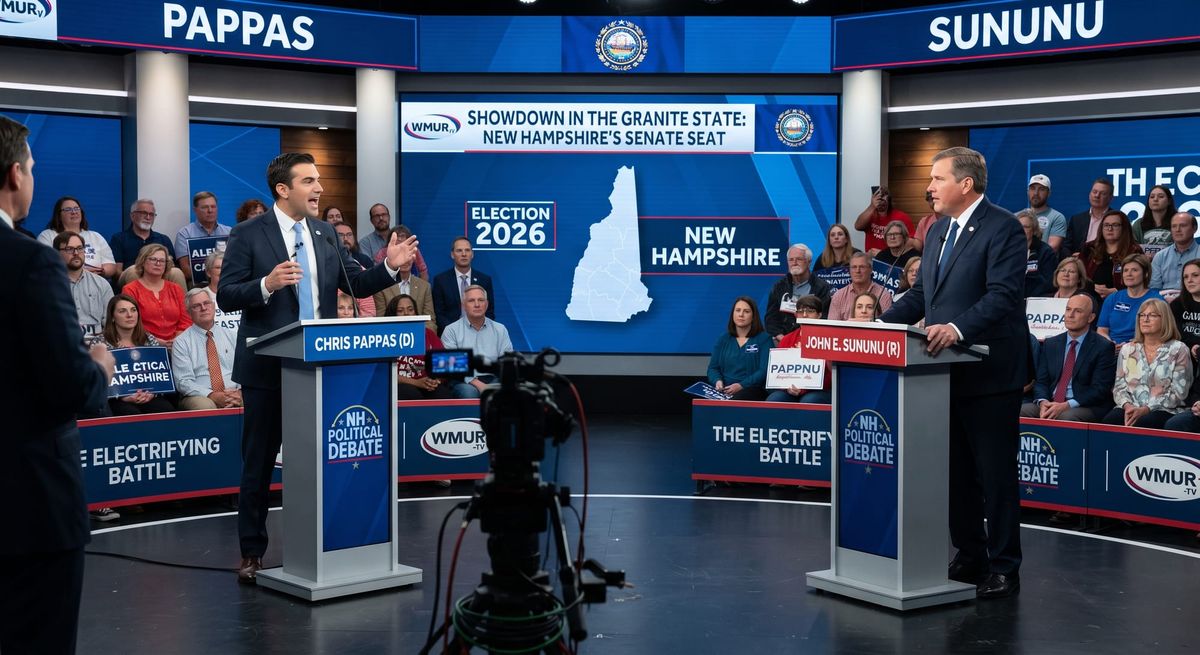
Let’s talk about one of the most exciting Senate races in the country: New Hampshire. For the first time in years, the seat is truly up for grabs. On the Democratic side, Chris Pappas—the current representative—is squaring off against Republican John E. Sununu, a former senator, to succeed Jeanne Shaheen. Just to set the scene: Harris carried the state by a modest 2.8 points in 2024, and no Republican has held this Senate seat since Sununu lost it to Shaheen back in 2008.
Fast-forward to this September, and things have gotten very interesting: both Cook and Inside Elections have now moved the race to “Toss-up.” Sure, prediction markets still have Pappas favored at about 84%, but with ratings tightening, a flood of GOP cash, and markets sometimes slow to catch up to the mood on the ground, this contest has everyone talking.
So, what’s at stake? Well, if Pappas manages to hang on, Democrats will likely keep—or even strengthen—their Senate majority. That would be a huge statement about the party’s staying power in New England, while also putting a damper on Republican hopes for a bigger national wave. But flip the script: if Sununu pulls off an upset, Republicans notch a prized pickup in deep-blue territory and suddenly, Democrats are forced onto the defensive. The whole battle for Senate control gets tighter, putting more pressure on Democrats to win in tough states and forcing both parties to rethink their strategies as 2028 approaches.
Mark your calendars: Election Day is November 3, 2026, with the primaries already in the rearview mirror after a lively contest on September 8.
How they got here
Let’s rewind and look at how we got here. In the Democratic primary, Pappas took about 65 percent of the vote, leaving Karishma Manzur with the rest. Top party figures—Shaheen, Maggie Hassan, and even Kamala Harris—lined up behind Pappas, but a week later, Manzur still hadn’t offered her endorsement. The Boston Globe summed it up: Pappas left the primary more bruised than Sununu. That’s a problem. If Manzur’s supporters sit this one out or can’t muster much enthusiasm, Democratic turnout could dip just enough to matter. And if the party can’t patch things up quickly, there’s a real chance progressives or younger voters drift toward third-party or independent candidates—adding another layer of suspense.
Switching to the Republican side: Sununu cruised through his primary, taking nearly 70 percent of the vote against former Massachusetts Senator Scott Brown. With Trump’s endorsement locked in and Brown out of the picture, it’s not a MAGA-versus-moderate standoff this time—just a straight shot to November.
But wait—there’s more! Several independent candidates and one from the Constitution Party are also in the race, polling between 1 and 4 percent according to Rasmussen. Their impact? It all depends on who they peel votes from. The bigger worry right now is on the Democratic side: if divisions linger, some of Manzur’s progressive supporters could be tempted by these alternatives, shrinking Pappas’s base. For Sununu, third-party candidates are less of a threat—unless, of course, an anti-establishment conservative gets a late surge. In other words, keep a close eye on how younger and progressive voters break in the final weeks.
The candidates
Let’s meet the candidates, starting with Chris Pappas. He’s a four-term congressman representing NH-01 (that’s Seacoast and Manchester, for those keeping score) and made history as New Hampshire’s first openly gay member of Congress. Pappas also runs his family’s restaurant in Manchester, giving him that local touch. In the Democratic world, he’s seen as a moderate—and he’s got Shaheen’s blessing as her chosen successor.
On the plus side, he brings the perks of incumbency in a swing district, impressive fundraising muscle ($15.4 million raised, $4.3 million still on hand as of mid-August), and deep ties thanks to the Harris/Shaheen/Hassan network. His challenges? The drawbacks of running for an open seat, lingering progressive tensions from the primary, and a Republican ad blitz targeting his connections to lobbyists.
Now, let’s turn to John E. Sununu. He’s no stranger to Granite State politics—he held this Senate seat from 2003 to 2009, comes from a political dynasty (son of a governor, brother of another), and started as an engineer before heading to the House and then the Senate. Shaheen took him out in the Democratic wave of 2008, but now he’s back, sporting a Trump endorsement for 2026.
Sununu’s got some serious advantages: his last name opens doors, he’s a household name, and having a popular GOP governor on the ticket doesn’t hurt. Plus, Republican outside groups are spending big on his behalf. On the flip side, he’s not the incumbent, 2008 is ancient history in campaign terms, and he’s got to navigate the complexities of running alongside Trump in a midterm.
Polls
How’s the race looking in the polls? Pappas is still clinging to a small lead, but it’s a real rollercoaster: depending on the survey, Sununu is up by 2 points, or Pappas is ahead by as much as 11.
| Poll | Dates | Pappas | Sununu | Spread |
| InsiderAdvantage ® | Sept 16–17 | 48% | 40% | D+8 |
| co/efficient ® | Sept 9–11 | 46% | 46% | Tie |
| Rasmussen | Sept 8–10 | 45% | 34% | D+11 |
| UNH | Aug 20–24 | 43% | 45% | R+2 |
| Saint Anselm | Aug 17–18 | 48% | 41% | D+7 |
| Fabrizio / NRSC ® | late Aug | 36% | 37% | R+1 |
Here’s how the polling aggregators saw things as of September 18:
- 270toWin: Pappas 46.3–43.0 (+3.3)
- RCP: Pappas +4.8
- DDHQ: Pappas +5.7
- Silver Bulletin: Pappas +5.0
- Wikipedia's score for the aggregators: Pappas with +4.2
- Pollsmax (a little older): Pappas leads by 5.2.
On the Democratic side, Rasmussen’s +11 is the only one that stands out; among the Republicans, UNH’s +2 lead for Sununu and the NRSC’s +1 are the cases in point. The most honest assessment is that Pappas has a +2 to +5 lead, with a large number of undecided or other voters (typically 8 to 15 percent). Independents from New Hampshire will decide this. Rasmussen showed Pappas at 49 percent among unaffiliated voters and 16 percent among Republicans.
And don’t underestimate the wild card: undecided and ‘other’ voters. New Hampshire has a long tradition of late-breaking decisions—especially among those who see themselves as independent or moderate. In past nail-biters, this group’s support has gone both ways. This year, it’s a mix of younger voters, unaffiliated independents, and progressives still licking their wounds from the primary. Add in some moderate Republicans wary of national trends, and you’ve got a recipe for late drama. Polls show these voters are still watching—waiting to see if Pappas can heal party rifts, or if Sununu can recapture his bipartisan brand. Their choice, likely made at the eleventh hour, could tip the race from close call to clear win.
Ratings
Ratings are split—and the momentum might just be shifting toward the GOP:
- Cook Political Report: Now a toss-up (it was moved from Lean D on September 15)
- Inside Elections: Toss-up (moved from Tilt D)
- RealClearPolitics: Toss-up
- Sabato: Lean D
- Economist / Race to the WH / Fox: Lean D
- Decision Desk HQ / FiftyPlusOne / Silver Bulletin / Split Ticket: Likely D
So why the sudden toss-up status? Cook’s Jessica Taylor points to a few big reasons: GOP outside groups are outspending Democrats, Sununu’s brand has real staying power, and a well-liked Republican governor on the ticket adds a boost. Of course, Sununu still faces the challenge of running with an unpopular Trump at the top of the ticket.
Prediction markets (September 19)
The markets have not taken Cook all the way to a coin flip.
- Kalshi shows Pappas at 84% and Sununu at 16%. Volume is about $915,000, with about 901,000 contracts traded and around 606,000 open. As for the race, Pappas raised $13.4 million compared to Sununu's $3.7 million during that crawl, and the presidential baselines are Harris at +2.8 and Biden at +7.4.
- Polymarket: Pappas 84%, Sununu 17%. The volume is about $105,000.
Interestingly, the prediction markets are leaning more toward DDHQ’s “Likely D” rating than Cook’s “Toss-up”—just like we saw in Maine earlier in the cycle. Investors are betting on the midterm environment and strong fundraising, while race handicappers focus more on Sununu’s brand and the GOP’s Super PAC muscle.
Money
When it comes to money, it’s a tale of two campaigns: Pappas has the edge in cash on hand, but Sununu is winning the air war thanks to a surge of outside spending.
FEC through August 19:
- Pappas raised $15.38 million. He spent $11.54 million. He has $4.25 million in cash.
- Sununu raised $4.12 million. He spent $1.10 million. He has $3.02 million in cash.
The other aspect is spending on outside campaigns. When the ratings changed, Cook said Republicans had nearly $16.6 million while Democrats had $9 million. Later, the Boston Globe/AdImpact estimated that GOP groups had about $45 million, compared with $25 million for Democratic groups. One Nation ran a $6 million advertising campaign focused on Pappas and involving an Amazon lobbyist. In late September, Pappas cut back on a small television campaign in Portland, Maine (about $25,000).
Boston remains the most expensive market to target. The increase in Republican outside spending has narrowed the polling gap slightly so far. However, public opinion still hasn't clearly shifted—Pappas's lead in the average polls has shrunk by about a point since the major GOP advertising campaigns started, though he still leads most polls.
Pappas can finance his own campaign. Still, he won't be able to meet the Republican independent-expenditure ceiling unless the DSCC and the allied Super PACs remain involved.
How should we read this race?
So, why is Pappas still the favorite? He’s running for an open seat in a state Harris won by three points; polling averages have him up by 3 to 5, and he’s sitting on a $15 million campaign war chest, backed by the Shaheen/Hassan machine.
But don’t count Sununu out. His family name still carries weight; he’s got Trump’s endorsement without any messy primary fight, and GOP governors on the ballot help the ticket. Republicans enjoy a two-to-one advantage in outside spending, and Cook/Inside Elections have already rated the race a toss-up. Plus, a couple of GOP and UNH polls show a dead heat. If Pappas can’t rally progressive supporters and Manzur’s voters don’t come back, his lead could evaporate.
What changed in September? It wasn’t just one thing: Sununu gained ground in UNH polling, GOP firms saw movement, Cook changed its rating, and Republicans started spending at Maine levels. Democrats had planned to go on offense in Ohio, Michigan, Alaska, and North Carolina, assuming New Hampshire would be safe. Suddenly, that’s no longer the case. A Sununu victory would force Democrats to defend every contested GOP seat, flipping the stakes in the race for control of the Senate.
The markets say Democrats have an 84% chance of holding the seat, and Pappas remains confident. Still, Cook warns against treating this like a reverse-Michigan scenario. As of September 19, polls put Pappas slightly ahead, ratings lean D but call it a toss-up, and the markets give him about 5-to-1 odds. But GOP money on the airwaves suggests the race is tighter than markets admit—making this the clearest ‘markets versus late spending’ showdown. If the next UNH or Saint Anselm poll shows Pappas up by 6, expect Cook to breathe easier. If it’s tied, 84% looks too rosy.
So what should you watch for down the stretch?
- Big new ad buys—if DSCC or Republican groups ramp up spending, the battle is heating up.
- Last-minute endorsements or high-profile visits that could energize turnout for either side.
- Signs of unity or division among progressives: Are Manzur’s supporters coming home, or staying away?
- Debate performances—these could sway late deciders if one candidate shines or stumbles.
- And of course, keep an eye on third-party polling. If a minor candidate surges, that could siphon crucial votes at the last minute.
Bottom line: This is the kind of race political junkies live for—volatile, unpredictable, and absolutely central to which party controls the Senate. Stay tuned, because in New Hampshire, it’s never over until every last vote is counted.