
Rewiring the Mature Mind: A Practical Blueprint for Neuroplasticity
Unlock the science of adult neuroplasticity. Learn how to combine physical movement, complex learning, and rest to actively rewire and strengthen your brain at any age.

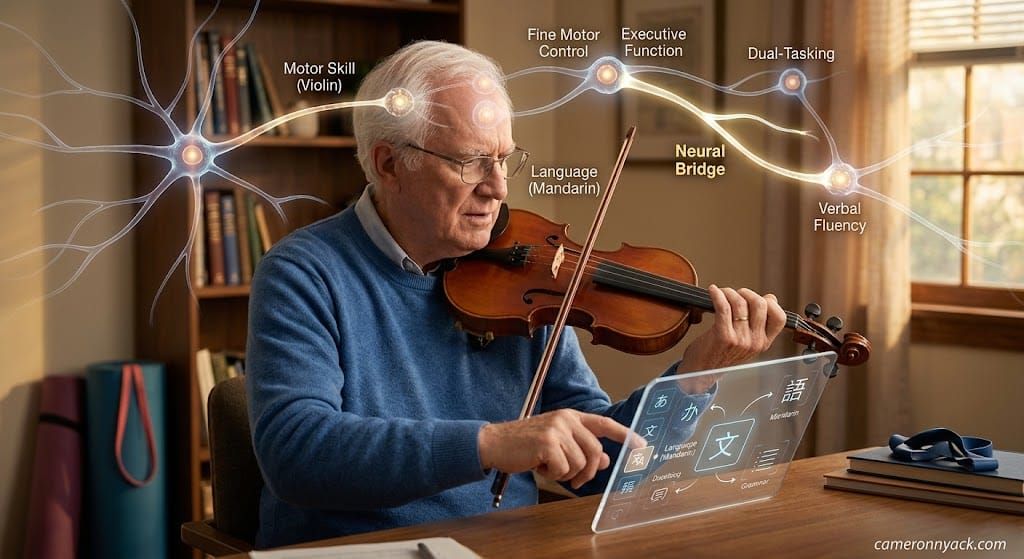
For a long time, scientists thought that adult brains couldn't really change or grow. They believed you were born with all the brain cells you would ever have, and that these cells just got weaker over time. But new research shows this isn't true. (Milbocker et al., 2024, pp. 75-95).
Even as you get older, your brain can still change and grow. This is called neuroplasticity. Your brain can make new connections, strengthen old ones, and even create new brain cells—especially in the part of your brain that helps with memory and learning. (Šimončičová et al., 2024, pp. 221-242)Making your brain stronger as an adult isn’t just about doing puzzles or simple memory games. You need to challenge yourself in new ways and try activities that make your brain work a little harder and feel a bit uncomfortable.
The Core Biology: How Pathways Form in Aging Brains
- To help your brain grow and stay healthy as you get older, you need three important things:
- Trying new things and accepting some frustration. This triggers the release of brain chemicals (such as acetylcholine and norepinephrine) that help your brain change and learn. (Mitsushima et al., 2013)
- Physical movement, like exercise. This releases chemicals (such as BDNF, VEGF, and IGF-1) that act like fertilizer for your brain, helping it grow new connections. (Acute cardiovascular exercise and circulating neurotrophic factors in humans: A systematic review and meta-analysis of mechanisms and methodological moderators, 2026)
- Deep sleep and rest. During sleep, your brain strengthens the changes you made during the day and makes them more permanent. (Tononi & Cirelli, n.d.)
- BDNF (Brain-Derived Neurotrophic Factor): You can think of BDNF as growth fertilizer for your brain. It helps keep your brain cells healthy and supports the growth of new ones. Activities like walking, lifting weights, or learning something new can boost your BDNF levels and help your brain stay sharp. (Knaepen et al., 2010, pp. 765-801)
- Acetylcholine & Norepinephrine: When you focus hard and feel challenged, your brain releases these chemicals, which help your brain know which connections to change and make stronger. (Silvetti et al., 2013)
- Consolidation: Your brain actually makes these changes stronger while you sleep, not while you’re awake and practicing. (Klinzing et al., 2019)
The Four Pillars of Neural Architecture
To keep your brain healthy as you age, you should focus on four main areas:
| Domain | Mechanism | Practical Target |
Cognitive Friction | Synaptogenesis via novel motor & intellectual learning | Complex tasks with high initial failure rates (instruments, languages, choreography) |
Cardiovascular Priming | Hippocampal perfusion & BDNF upregulation | Zone 2 aerobic base + interval spikes |
Sensorimotor Integration | Cerebellar and vestibular adaptation | Balance drills, dual-tasking, agile footwork |
Metabolic Optimization | Mitochondrial efficiency & glymphatic clearance | Consistent 7–8 hr sleep schedule, anti-inflammatory nutrition |
Step-by-Step Protocol to Rewire Neural Circuits
1. Start with exercise: Doing something like brisk walking or cycling before you do brain-training activities helps your brain get the most out of your efforts.
Exercise delivers more oxygen and helpful chemicals to your brain, making it easier to change and grow.
- Try 30 to 45 minutes of brisk walking, cycling, or another cardio activity most days of the week. Move at a pace where you can still talk, but you’re breathing a bit harder than normal.
- Do some strength training (like lifting weights or using resistance bands) two or three times a week. This helps your body release hormones that support your brain.
- The best time to work on brain challenges is 1 to 2 hours after you exercise, when your brain is primed to grow. For example, go for a walk, then later do a crossword or practice a language.
Choose activities that are new and a little hard for you, not just the ones you already know how to do. Doing crosswords and sudoku is good for keeping your brain active, but learning new things helps your brain build new pathways.
To force the brain to lay down entirely new wiring, the activity must combine novelty, progressive difficulty, and sensorimotor coordination:
- Playing a Musical Instrument: simultaneous visual interpretation, fine motor precision in both hands, auditory feedback loops, and rhythm.
- Learn a Complex Language: Expands working memory, verbal fluency, and executive control networks in the prefrontal cortex.
- Learn Partner Dancing or Martial Arts: Combines spatial orientation, balance, predictive timing, and social cognition.
- If something feels easy, you’re just using old brain pathways. If it feels a bit tough or frustrating, that’s when your brain is actually growing new connections.
Implement Dual-Tasking (Cognitive-Motor Coupling):
In younger brains, the spinal cord and cerebellum mostly automate balance and walking. With age, the brain relies more heavily on the prefrontal cortex for basic mobility. Training these systems together frees up executive capacity (Eggenberger et al., 2016)
- Motor-Cognitive Pairing: Walk a defined path while counting backward from 100 by 7s, naming an animal for every letter of the alphabet, or reciting a memorized passage.
- Vestibular Perturbation: Practice tandem stance (heel-to-toe standing) or single-leg balance on a foam balance pad while throwing a tennis ball against a wall or juggling scarves.
- Sensory Deprivation & Shift: Practice balance drills with your eyes closed (near a sturdy support) to force your brain to rely on proprioceptive pathways rather than visual cues.
Don’t be afraid to feel frustrated or challenged while learning something new. This is a sign your brain is changing for the better. Adults have to work a little harder than kids for brain changes to happen, but the effort is worth it.
If you make a mistake while learning something new, your brain releases special chemicals that help you remember and get better. Short, focused practice sessions (about 20-30 minutes) work better than long, distracted ones. (Health, 2021)Let your brain rest and sleep well, because most of the real brain growth happens while you sleep. (Lutz et al., 2024)Without structured recovery, the chemical tags placed during practice will fade without forming permanent architecture. (Neuroplasticity in Clinical Practice, 2015)
- Non-Sleep Deep Rest (NSDR): Take a 10–20-minute quiet rest or Yoga Nidra session immediately after an intense learning block. This accelerates the acquisition of motor and cognitive skills. (Boukhris et al., 2024, pp. 1967-1987)
- Try to sleep 7 to 8.5 hours each night in a cool, dark room. Deep sleep helps your brain clear waste and strengthen new memories. (Makin, 2019)
Weekly Sample Implementation Schedule
A good brain-health routine mixes mental challenges, exercise, and rest. To make your weekly plan even better, try some of these extra ideas: Change your walking or exercise route each week to introduce sensory novelty and spatial navigation challenges.
Add mindfulness meditation or breathing exercises in the evening to reduce stress and enhance memory consolidation. Include short, playful creativity sessions—such as sketching, improvisational music, or storytelling—to stimulate divergent thinking and activate the prefrontal cortex. Seek out new social experiences, like joining a club or volunteering, to expand your social cognition networks and emotional intelligence.
Regularly rotate the types of cognitive challenges (e.g., switch between languages, instruments, or games) to avoid plateauing and continually drive adaptive rewiring. Track your progress and reflect weekly on moments of challenge, frustration, and growth to reinforce neuroplasticity through conscious self-awareness. Schedule periodic assessments, such as memory recall tests or reaction time drills, to track improvements and identify areas that need further stimulation. Take brief technology breaks—step away from screens for at least 30 minutes daily to let your brain reset and engage with natural sensory input.
Experiment with cross-lateral movements (e.g., crawling patterns, tai chi, or dancing with alternating hand-foot coordination) to further integrate communication between the hemispheres. Dedicate time once a month to learn a completely unfamiliar skill (pottery, chess, digital art, etc.) to keep novelty and adaptive learning at the forefront of your growth plan. Foster intergenerational learning—teach a skill to someone younger or learn from someone older.
This exchange stimulates empathy, memory, and communication circuits in unique ways. Practice visualization techniques before challenging tasks (such as mentally rehearsing a dance step or musical passage), which strengthen neural patterning even before physical execution. Integrate nature-based activities beyond hiking—such as birdwatching, outdoor sketching, or gardening—to provide multisensory input and boost attentional networks.• Periodically vary your daily routine order (for example, do your cognitive task before exercise, or switch morning and evening activities). This disrupts habitual patterns and encourages new neural connections.
Mon / Wed / Fri:
- 08:00 AM: Brisk 30-min walk + balance drills (physical priming)
- 09:30 AM: 25-min high-friction learning (instrument, language, or complex task)
- 10:00 AM: 15-min NSDR / quiet rest (initial consolidation)
Tue / Thu:
- 09:00 AM: Strength training/resistance band complex
- 02:00 PM: Dual-tasking drills (motor + mental math or footwork drills)
Sat:
- Interactive social engagement (strategy board games, dance classes, community group projects)
Sun:
- Active recovery, nature navigation (unfamiliar hiking trails stimulate grid/place cells in the hippocampus) (Stensola & Moser, 2016)
5. Key Takeaways
- Feeling uncomfortable or challenged means you’re making progress. If it’s too easy, your brain isn’t really changing.
- Move your body and challenge your mind together. Exercise and mental training work best as a team.
- Practicing a little bit often is better than one long session. Four 20-minute practice times each week are better than one bisessions.
References
Milbocker, K. A., Smith, I. F., & Klintsova, A. Y. (2024). Maintaining a Dynamic Brain: A Review of Empirical Findings Describing the Roles of Exercise, Learning, and Environmental Enrichment in Neuroplasticity from 2017-2023.
https://doi.org/10.3233/BPL-230151
Šimončičová, E., Pekarik, K. H., Vecchiarelli, H. A., Lauro, C., Maggi, L., & Tremblay, M. (2024). Adult Neurogenesis, Learning and Memory. https://doi.org/10.1007/978-3-031-55529-9_13
Mitsushima, D., Sano, A., & Takahashi, T. (2013). A cholinergic trigger drives learning-induced plasticity at hippocampal synapses. https://doi.org/10.1038/ncomms3760
Moreau, D., & Chapple-De Lange, B. T. (2026). Acute cardiovascular exercise and circulating neurotrophic factors in humans: A systematic review and meta-analysis of mechanisms and methodological moderators. https://doi.org/10.1016/j.brainres.2026.150428 (PubMed link: https://pubmed.ncbi.nlm.nih.gov/42276185/)
Tononi, G., & Cirelli, C. Sleep and Synaptic Down-Selection.
https://www.ncbi.nlm.nih.gov/books/NBK435759/
Knaepen, K., Goekint, M., Heyman, E. M., & Meeusen, R. (2010). Neuroplasticity — Exercise-Induced Response of Peripheral Brain-Derived Neurotrophic Factor: A Systematic Review of Experimental Studies in Human Subjects.
https://doi.org/10.2165/11534530-000000000-00000 (Springer link: https://link.springer.com/article/10.2165/11534530-000000000-00000)
Silvetti, M., Seurinck, R., van Bochove, M. E., & Verguts, T. (2013). The influence of the noradrenergic system on optimal control of neural plasticity. https://doi.org/10.3389/fnbeh.2013.00160
Klinzing, J. G., Niethard, N., & Born, J. (2019). Mechanisms of systems memory consolidation during sleep.
https://doi.org/10.1038/s41593-019-0467-3
Eggenberger, P., Wolf, M., Schumann, M., & de Bruin, E. D. (2016). Neuromuscular Exergame and Balance Training Modulate Prefrontal Brain Activity during Walking and Enhance Executive Function in Older Adults.
https://doi.org/10.3389/fnagi.2016.00066
National Institutes of Health (NIH) (2021). How short breaks help the brain learn new skills. https://www.nih.gov/news-events/nih-research-matters/how-short-breaks-help-brain-learn-new-skills
Lutz, N. D., Harkotte, M., & Born, J. (2024). Sleep’s contribution to memory formation. https://doi.org/10.1152/physrev.00054.2024
Physiopedia (2015). Neuroplasticity in Clinical Practice.
https://www.physio-pedia.com/Neuroplasticity_in_Clinical_Practice
Boukhris, O., Suppiah, H., Halson, S., Russell, S., Clarke, A., Geneau, M. C., Stutter, L., & Driller, M. (2024). The acute effects of non-sleep deep rest on perceptual responses, physical, and cognitive performance in physically active participants. https://doi.org/10.1111/aphw.12571
Makin, S. (2019). Deep Sleep Gives Your Brain a Deep Clean.
https://www.scientificamerican.com/article/deep-sleep-gives-your-brain-a-deep-clean1/
Stensola, T., & Moser, E. I. (2016). Grid Cells and Spatial Maps in Entorhinal Cortex and Hippocampus.
https://www.ncbi.nlm.nih.gov/books/NBK435751/