Michigan’s High-Stakes Showdown: Can John James Topple Jocelyn Benson in the Governor’s Race?
Democrat Jocelyn Benson holds a solid lead over Republican John James in the high-stakes 2026 Michigan governor's race. Discover the latest polling data, campaign finances, and the key swing voters that could decide this crucial midwestern battleground.
Michigan Governor Race 2026: Can John James Topple Jocelyn Benson? | AVI Business Solutions
Get ready—Michigan’s gubernatorial race is shaping up to be a true political showdown! The latest high-quality polls put Democrat Secretary of State Jocelyn Benson ahead of Rep. John James, with Benson cruising to a 7- to 8-point lead. The betting markets? They’re giving her a whopping 90% shot at victory. That “Lean D to Likely D” rating isn’t just a technical term—it means Benson’s position is even stronger than what we saw in the Michigan Senate race (El-Sayed versus Rogers) I discussed earlier in this series. Sure, Trump managed to squeeze out a win in Michigan by 1.4 points in 2024, so James has a solid base to work with. But here’s the catch: while we know his support probably won’t dip below that Trump baseline, there’s no clear sign yet of how high he can climb. The stakes? Huge.
Circle November 3, 2026, on your calendar—this is when Michigan will decide its next governor. With Gretchen Whitmer stepping aside due to term limits, the field is wide open. On the Democratic side, we’ve got Senate Majority Leader Winnie Brinks, while Jay DeBoyer is running for the GOP. And just for a twist, Detroit Mayor Mike Duggan flirted with an independent bid, but that’s off the table now—the markets barely blinked, showing just a 0.5% shift on Kalshi. Let’s keep moving: who made it to the ballot, and how did the primaries shake out?
How did we get here?
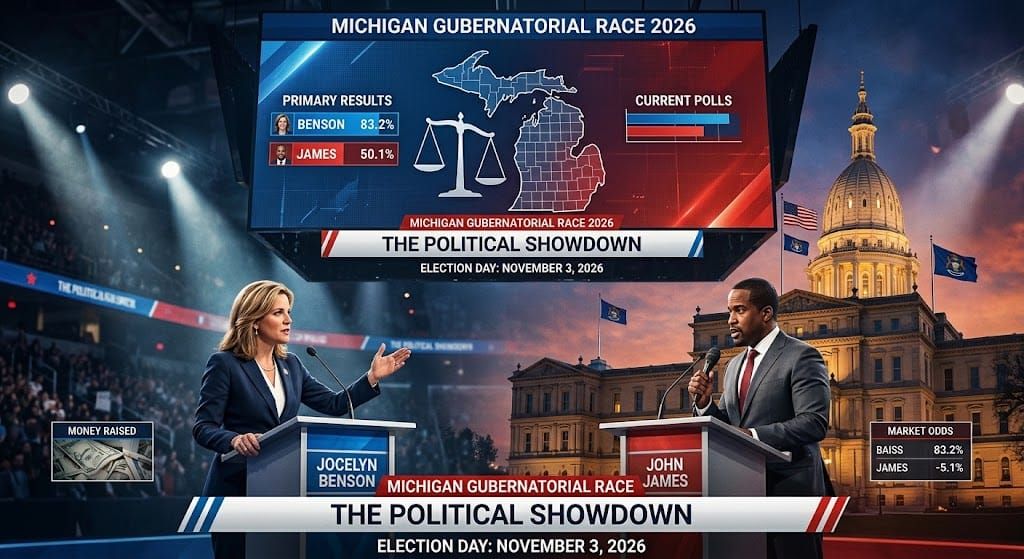
Let’s rewind to August 4th. In the Democratic primary, Benson absolutely dominated, grabbing 83.2 percent of the vote against Chris Swanson, Genesee County’s Sheriff. Whitmer stayed neutral at first, but after Benson’s landslide, she quickly threw her support behind the nominee. This was a drama-free nomination—the Democratic coalition stayed rock solid.
On the Republican side, things got a little wilder. John James eked out a win with 50.1 percent, just edging out Perry Johnson—the businessman who poured a jaw-dropping $33 million of his own money into the race, only to come up short. Trump’s endorsement gave James a boost, but it came at a cost: the primary drained his time and campaign war chest, leaving him at a disadvantage heading into the crucial final stretch.
The candidates
Let’s talk candidates. Jocelyn Benson isn’t just the current secretary of state—she’s been in the spotlight since 2019, refereeing voting rules in the thick of Trump-era lawsuits. A Detroit Democrat, Benson has built a reputation as a powerhouse election administrator. She’s backed by major labor groups like the MEA, UAW, and SEIU, as well as heavy-hitters like Whitmer’s PAC and the DGA. Translation: her campaign is sending a loud message on labor, costs, and wages. Her coalition? It’s a lot like Whitmer’s: 56 percent women, a good chunk of lean Republicans, and a group of undecided voters who really don’t like Trump.
Benson’s got plenty of strengths—she’s already won statewide, has four times as much campaign cash as James, and sailed through the primary. But there’s a catch: her high-profile role during the ultra-heated 2020 election put a target on her back for Republicans and some center-right independents, many of whom are convinced the election was mishandled. This could fire up Republican turnout and supercharge anti-Benson attacks, giving James a shot at closing the gap, especially in rural and outstate areas where doubts about the 2020 election run deep.
Now, meet John James. He represents MI-10 in Congress, is an Army veteran, and has twice run for Senate—losing both times to Stabenow, but gaining plenty of name recognition along the way. He’s got the backing of the Shelby Township Farm Bureau and a powerful DeVos-linked Super PAC, Mission Michigan. James is probably Michigan’s most battle-tested Republican this decade—though victory at the statewide level has always eluded him. Here’s what he brings to the table: broad name recognition, the ability to appeal as a Black Republican in a diverse state, and solid Trump support (without the bruising primary he’d have faced if Perry Johnson had won).
But he’s got baggage too—two statewide losses, a string of tough primaries, and that stubborn polling gap that won’t budge. Trump is working to boost turnout in his strongholds, pitching economic messages to suburban and rural men, and trying to broaden the GOP tent by spotlighting James’s military service and outsider image. James is also reaching out to Black voters in Detroit and Flint, and aiming to tie Benson to less popular Democratic figures. For James, it’s all about firing up the Republican base, flipping Whitmer voters, and tightening margins in those working-class, outstate counties.
Polls
So, how’s it going so far? Through the fall, James hasn’t led any reputable poll.
Poll
Dates
Benson
James
Spread
WaPo / Schar
Sept 10–14
53%
41%
D+12
Emerson
Sept 12–14
49%
42%
D+7
CNN / SSRS
Aug 31–Sept 6
50%
41%
D+9
Glengariff / Detroit News
Aug 31–Sept 3
47%
43%
D+4
MSU
late Aug
52%
43%
D+9
EPIC-MRA
late Aug
45%
41%
D+4
AARP
mid-Aug
49%
44%
D+5
TIPP
mid-Aug
53%
37%
D+16
Fox
mid-Aug
52%
47%
D+5 (RVs)
Let’s dive into the numbers—here’s how the latest polling snapshots break down as of September 17:
270toWin: Benson 50.2–42.0 (+8.2)
RCP: Benson +7.3
Silver Bulletin: Benson +7.8
Wikipedia's score for the aggregators: Benson with +7.6
Pollsmax puts Benson up by 6.6 points, and their model gives her an 80.2% shot at winning, projecting a final tally of 53.1 to 47.0. That’s a comfortable margin, but not quite a blowout.
And when it comes to official polls, Glengariff is the gold standard here—it shows Benson ahead by 4 points overall, and by a whopping 8 points among those certain to vote. There’s also a pocket of undecided voters who really don’t like Trump, tilting things further in Benson’s favor. In short: this isn’t a dead heat.
Ratings
Cook / Sabato / Fox / RCP: Lean D
Inside Elections: Tilt D
Race to the WH / Silver Bulletin / Pollsmax: Likely D
It’s not every day you see a Democrat with a solid lead in a state Trump carried—especially in a midterm year. Even after James’s primary win, none of the major handicappers have budged: they’re not calling this a toss-up. That’s how much of an edge Benson has right now.
Prediction markets (September 20)
The markets? They’re just as confident as the ratings.
Kalshi: Benson about 91 percent, James about 10 percent, Duggan 0.5 percent. Volume about $346,000. Race intel: Benson about 49 percent, James about 42 percent—presidential baselines: Trump plus 1.4, Biden plus 2.8.
The Polymarket/RCP widgets had previously been showing a position in the mid-80s for the Democratic candidate. According to Octagon's mid-September tracker, Benson was at ~90%.
The markets are viewing this the same way they do the Hobbs–Biggs (AZ) pairing, rather than the Lombardo–Ford (NV) or Crowley–Tiffany (WI) one. They are not basing the price of a James comeback solely on name recognition.
Money
Benson runs the campaign account, and James has a wealthy Super PAC.
As of Aug. 24:
Benson: $12.5 million raised so far in this cycle. $5.9 million in cash.
James has raised $6.4 million, consisting of about $1.1 to $1.5 million in cash.
By late July, the Mission Michigan Super PAC had spent $4.7 million or more, part of that amount coming from a $6 million contribution by DeVos. The $33 million that Johnson spent in his primary campaign did not pass to James. Both Whitmer's PAC and the DGA had reached their limit regarding Benson after August 4. The unions (UAW, SEIU, LIUNA, MEA) are supporting her. James will not win an outright battle on the money listed on the campaign books; instead, he will need volume from Super PACs and a late shift among men and outstate whites.
So, how should we read this race?
Benson is the favorite because in the latest national polls he leads by between seven and twelve points, has the advantage in the Lean/Likely D ratings, is ahead in 90 percent of the markets, has a 4-to-1 advantage in cash, secured a decisive victory in the primary, benefits from Whitmer's coalition along with the SOS turnout machine, and has the advantage in the midterm map. Glengariff has defected from the lean-Republican side, and the female margin is the same as with Whitmer.
But don’t count James out just yet. Michigan is still a one-point Trump state, and while James has come up short twice statewide, he’s not a political unknown. Some polls, like Fox’s RV sample, put the race within five points. If the Senate contest heats up and gets more GOP voters to the polls, and if Benson becomes the poster child for 2020 election controversies, a four-point lead could vanish. Midwest open seats have delivered surprises before—think Tony Evers hanging on in Wisconsin in 2022, Kim Reynolds dodging an upset in Iowa in 2018, or Illinois flipping in 2014 after a late Republican surge. In other words, late-game plot twists? Totally possible.
In the Michigan Senate race, the contest between El-Sayed and Rogers is the closer one at the federal level, and the race between Benson and James is the one where Democrats have a better chance of winning. It would be wrong to assume they always move together; ticket-splitting is common here.
And let’s not forget the national stakes. Michigan is one of only five Democratic governorships up for grabs in a state that went for Trump. If Benson hangs on, Democrats keep a crucial foothold. If James can pull off a comeback, it’s a huge Republican win in a pivotal Big Ten state—and a personal redemption after two tough Senate losses.
Fast-forward to September 20, and here’s where things stand: Benson is still up by seven in the polls, the ratings lean her way, and betting markets are giving her nearly 9-to-1 odds. She’s got the campaign cash advantage, and even the outside money expects James to put up a fight on TV. But don’t be fooled—this isn’t Nevada or Alabama. We’re talking about an open seat in a purple, Democratic-leaning battleground. James has just six weeks left to try and shake up a race that’s barely budged since spring. Can he do it? That’s the drama we’ll be watching down the stretch.
So, what’s really on the line? For Democrats, holding onto the governorship means they can keep pushing Whitmer-era policies—think reproductive rights, labor protections, environmental rules, and voting access. For Republicans, flipping this seat would be a massive Midwest victory and give them more power over taxes, education, and the rules for future elections. But the big picture is this: this race tests both parties’ strength with swing voters in a state that could help decide who controls the White House and Congress in 2028.