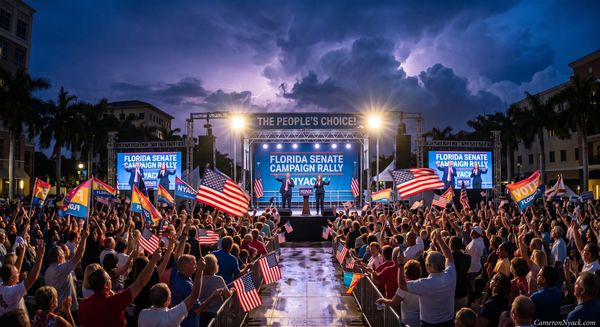
Clash in the Heartland: Michigan’s Senate Race Holds America’s Future in the Balance
Michigan's 2026 Senate race between progressive Abdul El-Sayed (D) and Republican Mike Rogers is a dead heat. With control of the US Senate on the line, dive into the latest polls, prediction markets, and key factors shaping one of the most critical and fiercely contested elections of the year.

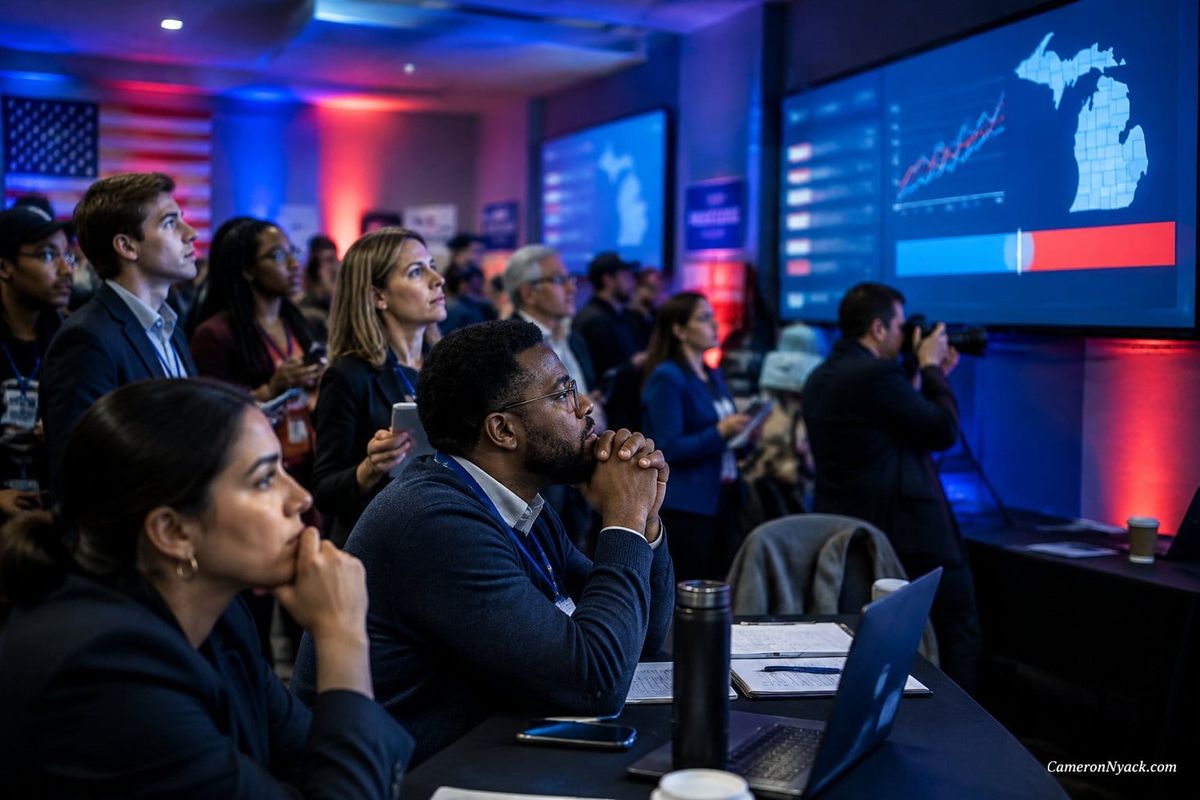
Michigan's Senate race is electrifyingly close, with every poll and prediction market fueling the suspense. Right now, the Democrats have a slight edge—Abdul El-Sayed (D) is outpacing Mike Rogers by just 1–3 points in the latest polls, and prediction markets are buzzing with a 64–66% chance of an El-Sayed victory. This isn’t just any contest: it’s one of the most pivotal showdowns of 2026, as Michigan is the only Democratic-held Senate seat in a state Donald Trump carried in 2024. With Republicans hungry for their first Michigan Senate win since 1994, the stakes couldn’t be higher. Mark your calendar for November 3, 2026—this is when Michigan’s political drama reaches its crescendo. With Democrat Gary Peters bowing out, the stage is set for a fierce and unpredictable showdown.
The candidates
Abdul El-Sayed (D), 41, brings an electric presence to the race—a Michigan-born epidemiologist and trailblazing former public-health official. With Egyptian roots and a story that could make history as the nation’s first Muslim U.S. senator, El-Sayed’s credentials are dazzling: degrees from Michigan, Oxford (as a Rhodes Scholar), and Columbia, plus a record as Detroit’s youngest-ever health director and a bold run for governor in 2018. His candidacy injects fresh energy and ambition into the contest.
He is a progressive and supports Medicare for All, has called for the abolition of ICE and replacing it with something more like the previous INS, opposes unconditional military aid to Israel, and refuses to accept money from corporate PACs. He has employed the term "genocide" in relation to Gaza. Endorsers include Bernie Sanders, AOC, Elizabeth Warren, the UAW, and (after the primary) party leaders such as Schumer, Peters, Whitmer, and Buttigieg. He won the primary on August 4, 48.5 percent to 47.5 percent, against Rep. Haley Stevens; it was one of the most costly Senate primaries ever, with AIPAC-aligned groups spending about $30 million against him.
Mike Rogers (R), 63, enters the race as a battle-hardened contender. His resume reads like a political thriller: Army officer, FBI special agent tackling organized crime and corruption in Chicago, state senator, and seven-term U.S. Congressman who once chaired the powerful House Intelligence Committee. After leaving Congress, he dove into the fast-paced world of cybersecurity, advising top firms. In 2024, Rogers came heartbreakingly close to a Senate win—losing by a razor-thin margin to Elissa Slotkin. Now, with Trump’s personal encouragement and the Detroit News at his back, Rogers is back in the ring for another shot at victory.
About policy, Rogers backs strengthening border security and is against providing pathways to citizenship for undocumented immigrants. He doubts single-payer healthcare and prefers market-based reforms. Rogers supports business-friendly economic policies, such as tax cuts and reduced regulation. He supports increased defense spending and has criticized what he calls "radical" changes to policing or immigration enforcement. He also supports domestic energy production and has opposed the Green New Deal.
El-Sayed accuses Rogers of being a Trump "sock puppet" and of serving as a consultant for companies on a revolving-door basis. In reply, Rogers says El-Sayed is too far to the left, points to donations linked to CAIR (about $130,000), and frames the situation as "common sense against ideological fanaticism." These attacks aim to shape how voters see the candidates by focusing on each one's apparent shortcomings and turning the election into a vote on values and character. While negative campaigning can energize a candidate's core supporters, it also risks pushing away swing voters if the attacks seem unfair or overdone.
Moreover, Rogers missed the September 15 FOX 2 debate; El-Sayed appeared alone and called him a coward. Some voters may see the decision to avoid a debate as a sign of confidence or a strategic choice. Still, it could also suggest evasiveness or a lack of transparency, which may reduce a candidate's appeal to undecided voters.
Polls: The Pulse of a Nail-Biter (as of September 17, 2026)
In almost every recent survey, the race is within the margin of error.
| Pollster | Dates | El-Sayed | Rogers | Spread |
| Washington Post–Schar | Sept 10–14 | 48% | 45% | D+3 (MOE ±3.9) |
| Emerson | Sept 12–14 | 48% | 46% | D+2 |
| Trafalgar | ~Sept 7–9 | 46% | 45% | D+1 |
| CNN/SSRS | late Aug–early Sept | 47% | 44% | D+3 |
| Glengariff | early Sept | 44% | 46% | R+2 |
| MSU | early Sept | 50% | 45% | D+5 |
The latest numbers have campaign headquarters on both sides buzzing with anticipation. According to 270toWin, El-Sayed holds 46.6% to Rogers’s 45.2%. RealClearPolitics had him up by +1.8 earlier, and Pollsmax puts the race at about D+1.4. Every decimal point feels like it could tip the balance. Important internals from the Post and Emerson:
- In the educational split, voters who do not attend college tend to support Rogers, while those who have attended college prefer El-Sayed.
- Independents slightly favor El-Sayed.
- 48 percent think that El-Sayed is 'too liberal' and 43 percent believe that Rogers is 'too conservative'.
- Both candidates have negative net popularity, with El-Sayed enjoying slightly higher favorability (44% according to the poll versus 39% for Rogers).
- In the polls, 53 percent of likely voters want Democrats to control the Senate, but El-Sayed does not meet this general preference. In the same polls, Democrat Jocelyn Benson leads the governor's race by a margin of 7 to 12 points.
The main point is the greatest risk facing the Democrats. Although the environment is favorable, El-Sayed is running further left than is typical for a statewide Michigan Democrat.
Expert Ratings: High-Stakes Verdicts
Consensus is Toss-up to Lean Democratic:
- Cook Political Report: Toss-up
- Sabato’s Crystal Ball: Toss-up
- Inside Elections: Toss-up
- RealClearPolitics: Toss-up
- Decision Desk HQ, The Economist, Split Ticket, Silver Bulletin: LeanD
Cook places Michigan in the exclusive club of undecided seats that will decide the fate of the Senate. With Republicans sitting at 53 seats, Democrats must pull off a net gain of four to seize control (with Vice President JD Vance poised to cast a tiebreaker if needed). Losing Michigan would mean the Democrats face a near-impossible climb—flipping five other seats to keep their Senate hopes alive.
Prediction markets (September 17, 2026)
People are more optimistic about El-Sayed than the raw polling averages.
- Kalshi (the highest volume): El-Sayed at 65 cents (implying 65%). About 3.65 million contracts have been traded, and there is about 2.53 million open interest; this contract has been one of the more active in the Senate markets.
- On Polymarket, El-Sayed has odds of ~65%, and Rogers has them at 34–35%. The volume is around $800k to $833k.
In September, some snapshots put El-Sayed in the high 50s to low 60s; prices have since moved toward the mid-60s as the midterm environment and the most recent polling have been factored in. Unlike ordinary opinion polls, prediction markets draw together information from a wider range of signals, not only recent polls but also fundraising activities, breaking news, the quality of the candidates, outside spending, the perceived motivation of each side's voters, and traders' private views regarding turnout or last-minute shifts.
Traders enter contracts based on their own research and expectations, so market prices reflect the consensus probability given all visible information and incentives. The markets have performed well in forecasting the outcomes in the 2024 swing states; while they do not guarantee the results, they do take into account more than just a simple average of the polls (such as the national climate, candidate quality, the amount of money involved, and traders' beliefs about turnout).
The difference between the forecasters' figure of Lean D and the current 65% level is small. In a midterm scenario that favors the opposition party, a two-point poll lead corresponds to a 60–65% chance of winning, according to many models.
Money and outside spending
Through mid-July FEC reports (latest comprehensive snapshot widely cited):
- El-Sayed has raised about $14.5 million and has about $2.55 million in cash.
- Rogers raised about $10.8 to $10.9 million and had about $4.2 to $4.5 million in cash (he had no primary).
The Democratic primary received a large amount of money from outside sources (some estimates putting it at over $60 million), with the spending largely in support of Stevens and AIPAC. In the general election, Senate Majority PAC/WinSenate and several other Democratic groups have set aside tens of millions of dollars against Rogers. At the same time, Republican and associated groups will also spend heavily. Although El-Sayed has taken the position of not accepting money from corporate PACs, aligned Super PACs have still spent money to support him. Rogers is starting the fall campaign with more cash.
How to read the race
The reasons why El-Sayed can win are: the president's party having suffered a setback in the midterm elections, Trump's weak performance in Michigan, strength in educational areas and suburbs and in college towns, the presence of youthful energy, party unity following the primary, and a modest but steady lead in the polls. The financial markets and various models regard that combination as a Lean D.
Rogers can win because he is a well-known commodity candidate who in 2024 came within a third of a point of winning. El-Sayed is more to the left than Peters/Slotkin/Whitmer-type Michigan Democrats on issues such as ICE, Israel, and single-payer health care; almost half of the voters already regard him as too liberal—non-college and older voters prefer Rogers. Skipping the debate and trading personal attacks has not yet decided the race either way.
The key uncertainties include voter turnout—particularly among young people and Arab-Americans as compared to rural and working-class Republicans— the large amount of money raised by late Super PACs, whether El-Sayed's stance on Israel and ICE has a greater effect in suppressing suburban Democrats than in mobilizing the left, and whether Rogers will be able to distance himself from the unpopularity that Trump has in Michigan without losing the Republican base.
Third-party candidates are on the ballot—such as Libertarian Lydia Christensen, Green Douglas Marsh, and U.S. Taxpayers Timothy Long, among others—but they are not currently showing up as decisive in the polls. Yet, if the race becomes more closely contested, even a small number of voters switching to a minor party could make a difference. In a contest of this kind, votes given as a form of protest by dissatisfied Democrats or Republicans, or by voters who are unhappy with both of the main candidates, could change the result if the margin narrows to just a few thousand votes.
For instance, the Libertarian or Green candidates might take enough votes away from Rogers or El-Sayed, respectively, to affect the outcome. Although their current polling figures are low, voters should watch third-party candidates in a polarised race.
As of September 17, the polls indicate a coin flip with a slight edge to El-Sayed. The ratings suggest a toss-up, or a very slight edge to the Democrats. Real-money markets show El-Sayed as the favorite at about 2-to-1. To put this in context, Michigan Senate elections have generally gone to the Democrats in the past twenty years: Gary Peters won by 1.7 points in 2020, Debbie Stabenow by 6.5 points in 2018, and Peters by 13 points in 2014. The state has not seen a Republican win a Senate seat since 1994, and the most recent races have been less competitive than this one. The most accurate description is that it is a close race in which the current national environment offsets El-Sayed's ideological misalignment with the typical Michigan voter, although not sufficiently to make it safe.