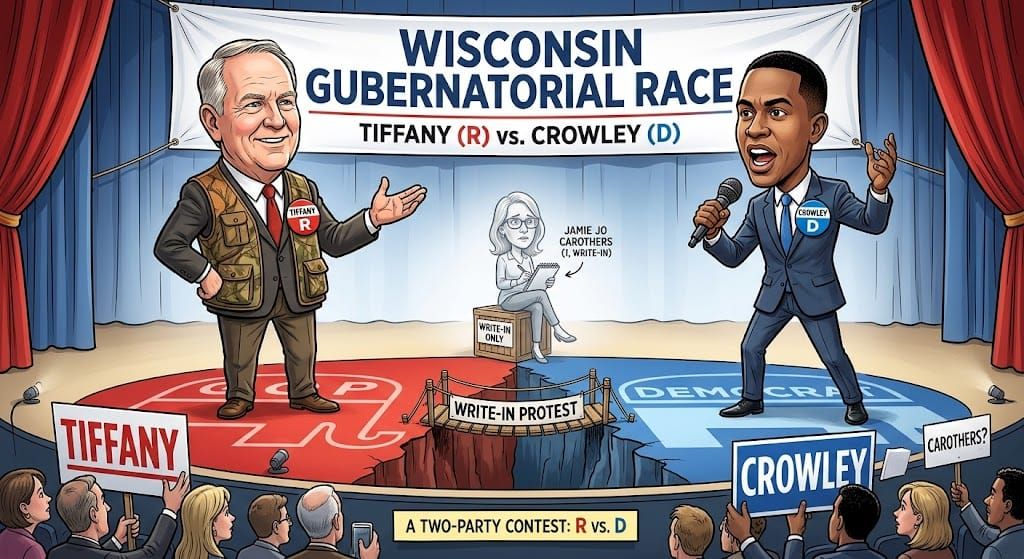
Let’s cut through the confusion: Jamie Jo Carothers, an independent write-in candidate, isn’t a real contender for Wisconsin’s governorship. The spotlight is firmly on Tom Tiffany and David Crowley (D), who are squaring off to fill the seat left open by Tony Evers. Why not treat Carothers as a serious challenger? She’s not the nominee of any major party; you won’t find her in public polls, and prediction markets like Kalshi or Polymarket don’t even offer odds on her. So, here’s how the real race shapes up—with Carothers in her proper context, and all eyes on Tiffany and Crowley.
Before we dive into the numbers and narratives, let’s set the stage with a quick look at Wisconsin’s political backdrop. In 2024, Trump won Wisconsin by approximately 0.9 points. State history shows Democrats have never held the governorship for more than eight consecutive years, so Evers's two terms reached that maximum.
Republicans control the legislature. The winner, along with the results from the lower ballots, will determine whether Democrats retain the triplex (comprising the governor, the attorney general, and the secretary of state) or whether Republicans must later create a route to a trifecta. If Democrats keep the triplex, they can block or influence Republican legislative priorities, preserve current voting and election rules, and maintain their leverage in redistricting disputes. A Republican trifecta, on the other hand, would enable the streamlined passage of conservative legislation on taxes, education, and voting laws and could attract national attention by serving as a model of GOP policy or as a battleground for federal challenges.
So who is really listed on the ballot?
- Tom Tiffany ® is a nominee. In the primary held on August 11, he won 95.3 percent to 4.6 percent against Andrew Manske. He received Trump's endorsement after Josh Schoemann withdrew. His running mate is David Varnam, the mayor of Lancaster.
- David Crowley (D) is the nominee. He is Milwaukee's county executive. After temporarily suspending and then re-entering, he defeated the progressive state representative Francesca Hong; Evers endorsed him on July 18. His running mate is Sarah Godlewski, the Secretary of State.
- Jamie Jo Carothers (I) — submitted as a write-in. According to Ballotpedia, she has an associate degree from Northeast Wisconsin Technical College and is listed as a writer; she has no record of participating in any polling or fundraising activities and does not appear on any debate circuit. Write-ins in Wisconsin gubernatorial races are symbolic.
She only alters her first-choice vote in maths when she has to peel away protest votes in a race tied by just one point, and there is no indication she will do so. The only way Carothers could make a difference would be if the race were extremely close and she could secure enough dissatisfied votes from one of the two major-party candidates to overcome the margin between them. For Carothers to have an impact, the race would have to become so tight as to be a true dead heat, and her write-in vote totals would have to rise suddenly—an outcome which is not supported by present polling or by historical trends, but which might still happen if late developments lead to widespread disaffection.
Tom Tiffany
Since 2020, he has been the U.S. Representative for Wisconsin's seventh district (the northern and central parts of the state); earlier in his career, he served as a state senator and as a member of the state assembly; he was also a previous owner of Wilderness Cruises. He is a rural conservative and has advocated for taxes to be kept low, supported the freeze on University of Wisconsin tuition, maintained opposition to property and income taxes, opposed the 765-kV transmission line, endorsed the dairy industry, and, in his backlash advertisements against data centers, referred to Crowley as "Data Center David".
According to a Wisconsin Watch fact brief, he supported the Texas brief before the U.S. Supreme Court, objected to the electors from Arizona and Pennsylvania on January 6, and, while acknowledging that Biden won, still welcomes inquiries into the 2020 election. He skipped all but one debate (breaking the Broadcasters Association's streak). The Republican Party's outside groups are spending over $8 million more than the Democrats; Tiffany has an air advantage of about 3-to-1.
David Crowley
Evers's selection for the position of Milwaukee County executive, a choice that came after a complicated primary. Key messages include a commitment to affordability, an anti-corruption stance (including a ban on officials trading stocks and a prohibition on public officials participating in prediction markets), and a preference for less disruptive energy alternatives. Within Marquette, the results stand at 55–16 among likely voters—this is the entire race if that result holds.
Polls (Crowley vs. Tiffany)
Crowley has led all post-primary public opinion polls, typically by 3 to 5 points among likely voters. Polls based on registered voters show a tighter spread.
| Poll | Dates | Crowley | Tiffany | Notes |
| Marquette LV | Aug 12–20 | 49–51% | 44–47% | D+3 to +5 LV; 44–44 among all RVs |
| TIPP | mid-Aug | 47% | 43% | D+4 |
| Platform / Badger | mid-Aug | 48% | 44% | D+4 |
| GBAO (D) | late July–early Aug | 47% | 44% | D+3 |
| RMG | late July | 46% | 43% | D+3 |
Averages:
- 270toWin: Crowley 47.5–43.5 (+4)
- Pollsmax: Crowley has 46.9–46.5 (+0.3), model Tilt D, 54.9% for Crowley, with a projected result of 50.5–49.5
Marquette is the leading state poll; the difference between the LV and RV figures reflects enthusiasm, since 84 percent of Democrats say they are certain to vote, compared with a less enthusiastic share of the GOP. The independents in that LV sample support Crowley, which is why the markets are not viewing a +3-point lead as a true toss-up.
Ratings
- Ballotpedia summary of forecasters: Toss-up or Lean D
- Pollsmax: Tilt D
With an open seat in a state that’s nearly split down the middle—and a Democratic primary that surprised almost everyone—it’s anyone’s game. No outcome here is guaranteed, no matter which way you look at it.
Prediction markets (September 20)
The markets are far more optimistic about Crowley than average polls suggest.
- Kalshi shows Crowley at 83% and Tiffany at 17%. Trading volume is about $1.3 million, and on the margin contract, Crowley leads by 4 points at about 61%.
- At Polymarket, Crowley has 84% and Tiffany 16%, with volume being around $593k.
The gap between the market and the poll is larger than in Nevada and more in line with New Hampshire's Senate race (Pappas at 84% while Cook is listed as Toss-up). Traders are factoring in midterm turnout and Crowley's lead as an independent, not Trump's 0.9-point advantage in the presidential race. Prediction markets can differ from polls for several reasons: traders might be responding to up-to-date fundraising or spending figures, acting on insider information, or showing biases driven by recent events or broader national trends.
Moreover, trading activity and traders' risk tolerance can widen discrepancies, particularly in races where a specific group of bettors strongly favors one side. Here, optimism about Crowley rests on his strength among independents and on doubts that late Republican gains will materialize, even though the polling margins are narrow.
Carothers is not available at a significant price.
Money and tactics
Tiffany is blitzing the airwaves, but Crowley is holding his ground in the polls. Republicans and their allies are outspending the other side by more than $8 million, and Tiffany’s ads are popping up about three times as often as Crowley’s. The big flashpoints? Data centers and the controversial 765 line. Tiffany, seemingly betting big on media saturation, even called off extra debates—a classic move when you think your TV spots will do more talking than a stage ever could. All this spending could sway undecided and independent voters, who tend to be most receptive to ads. But here’s the twist: Crowley’s edge in the polls hints that his message is catching on organically, without all the noise. This head-to-head in strategy could be the deciding factor, especially if voters are still making up their minds down the stretch.
How one should go about reading the case Tiffany v. Carothers
There is nothing for anyone to read: an independent candidate with no share of the vote cannot overcome a member of Congress who is currently serving. If anyone is presenting that contest as the 'real' one, it must be due to a mix-up with the three-name listing on Ballotpedia or an effort to avoid mentioning Crowley. The only available figures are Crowley versus Tiffany.
Bottom line as of September 20
Carothers: the write-in option is not relevant.
Tiffany vs. Crowley: polls Crowley +3 to +5 LV, dead heat on registered voters. Ratings: Toss-up to Tilt/Lean D. Markets: Crowley ~5-to-1. GOP has the money; Democrats have the midterm and the independents in Marquette. This is an open purple-state governorship, not a Tiffany coronation and not a third-party race.