Get ready, Arizona—this is a competitive governor’s race between incumbent Democratic governor Katie Hobbs and Representative Andy Biggs (R), a Trump-endorsed Freedom Caucus member. Voters will also see a lieutenant governor ticket for the first time: Hobbs has teamed up with former Republican Mesa mayor John Giles, while Biggs is running with ex-state senator Sine Kerr. Trump carried Arizona by 5.5 points in 2024, and Hobbs won by 17,000 votes in 2022. Polls, pundits, and betting markets favor Hobbs, but the result remains uncertain.
Circle November 3, 2026. Republicans held their primary on July 21.
How did these contenders reach this point?
On the Democratic side, Hobbs won the primary with no opposition.
Meanwhile, Andy Biggs won the Republican primary with 73.6% of the vote, while David Schweikert finished at 14.7%. The others were in single digits. Trump’s endorsement helped, and Republican voters chose the candidate with the strongest conservative profile.
The candidates
Let’s meet the contenders. Katie Hobbs has been Arizona’s governor since 2023, after serving as secretary of state and in the legislature. Her 2022 win was the closest governor’s race in the country. In 2026, Hobbs is running on border security, tax cuts, and the addition of a Republican running mate. She is appealing to the middle in a Trump-leaning state. To win over undecided and swing voters, Hobbs is holding town halls on bipartisan issues, running ads with Republican supporters, and holding coalition events with business and law enforcement leaders. Her campaign pitch is local solutions, not partisan conflict—a promise of stability and practical governance. On paper, she has several advantages: incumbency, a midterm climate, Giles offering suburban credibility, and a steady polling lead. But challenges remain: her last win was narrow, Trump took Arizona in 2024, and her approval numbers have dipped at times during her term.
Andy Biggs has represented Arizona’s East Valley (AZ-05) since 2017, and before that, he led the state Senate and helped launch the Freedom Caucus. Democrats are attacking him over his election-denial record and his January 6 subpoena, but Biggs is staying the course. For this general election, he is emphasizing his Freedom Caucus roots, leaning into his alliance with Trump and his opposition to Biden’s agenda. Rather than chase suburban moderates, his campaign is focused on mobilizing the Republican base. His strengths? He has support from Trump-aligned voters, access to national right-wing dollars and energy, and he emerged from the primary in a strong position. The challenges? He is to the right of many Arizonans—and voters here have a reputation for split-ticket voting and for sending moderates like Kyrsten Sinema to Washington. Plus, Kari Lake already tried the 'hard MAGA versus Hobbs' approach…and lost.
Polls
Now, let’s talk numbers—because everyone wants to know: who’s ahead? The polling cited here mostly shows Hobbs ahead, but that lead depends on which polls are included, what time period they cover, and how you read the averages. In the polls cited here, a large pool of undecided voters keeps things uncertain. Most of those voters are in Maricopa County and the outer suburbs—think college-educated independents and younger Latino voters under 40. Their main concerns are the border, inflation, and frustration with national politics. One thing they share is that they’re not firmly tied to either party, which means they’re still up for grabs.
| Poll | Dates | Hobbs | Biggs | Spread |
| HighGround | mid-Aug | 50% | 34% | D+16 |
| Noble Predictive | mid-Aug | 48% | 35% | D+13 |
| AARP / Fabrizio-Anzalone | late July–early Aug | 52% | 44% | D+8 |
| Quantus Insights ® | mid-Aug | 49% | 43% | D+6 |
| Stealth | mid-Aug | 43% | 38% | D+5 |
| NextGen ® | mid-Aug | 39% | 38% | D+1 |
Let’s take a quick look at the latest scoreboards. Here’s how the polling aggregators cited here have been showing the race as of mid-August and early September, based on the polls referenced in this piece, and how they compare with the race averages:
- RCP: Hobbs +10.8
- 270toWin: Hobbs 45.8–37.6 (+8.2)
- Wikipedia's score for the aggregators: Hobbs with +8.4
- Pollsmax shows Hobbs leading by 6.7 points, projecting 52.8–47.3 and giving her an 80.4% chance of winning.
Republicans point to the NextGen poll—39–38 with 22% still undecided—as their source of hope. But even there, Hobbs is narrowly ahead. And in the September surveys cited here, Biggs hasn’t led once.
Ratings
Democratic, not a toss-up:
- Cook: Lean D (was Toss-up earlier; moved toward Hobbs)
- Sabato: Lean D
- Inside Elections: Tilt D
- RCP / Fox: Lean D
- Silver Bulletin / Race to the WH / Pollsmax: Likely D
Political analyst Charlie Cook sums it up: Hobbs may be one of the more vulnerable Democratic incumbents, but Biggs is a 'polarizing and deeply conservative' challenger—and the national mood is not the same as the 2024 presidential cycle.
Prediction markets (as of mid-September)
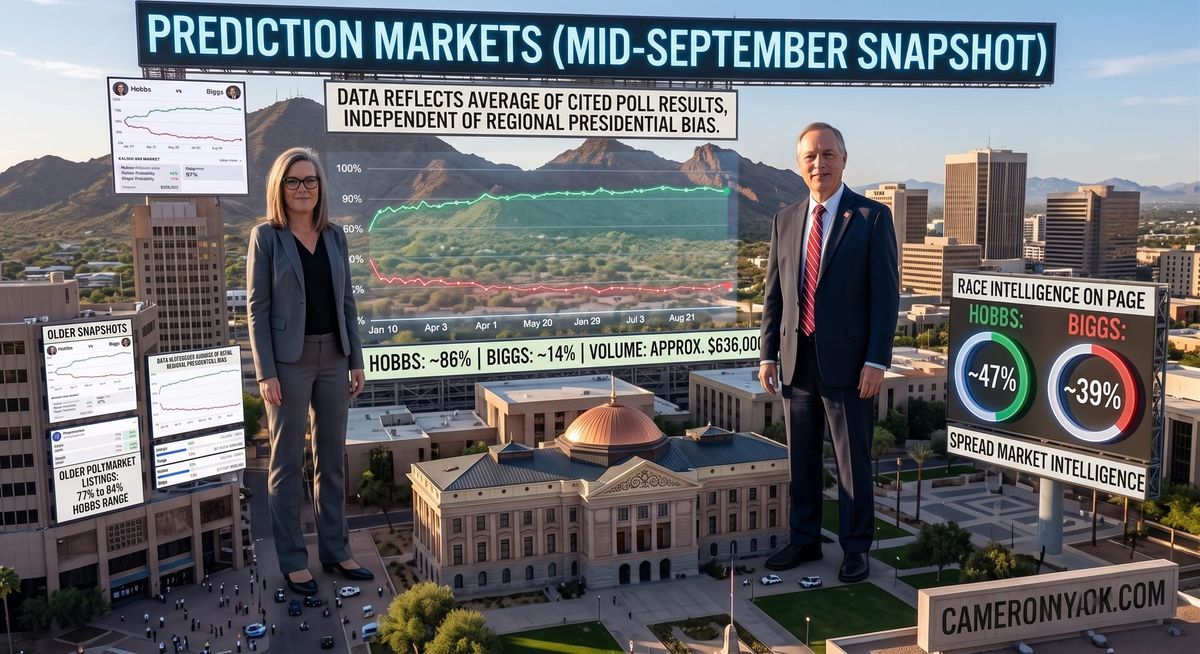
In line with the average of the poll results cited here, not with the presidential bias of Arizona.
- Kalshi shows Hobbs at ~86% and Biggs at ~14%. The volume is approximately $636,000. According to the race intelligence on the page, Hobbs is at ~47% and Biggs at ~39%. The spread is in the money market, favoring Hobbs by 11+ points.
- Other snapshots: Octagon/Kalshi-style feeds show 87% Hobbs; older Polymarket listings fall in the 77-84% Hobbs range.
Both the betting markets and Pollsmax (hovering around 80%) are pointing the same way. This isn’t like Alaska, where the betting world expects a Democrat to win deep-red turf. In Arizona, it’s about incumbency, a midterm boost, and a Republican candidate that may be too far right for the suburbs.
Money and message
Let’s talk cash and campaign strategy. Hobbs is using her incumbent fundraising advantage, pouring money into ads about border security and tax cuts—issues often associated with Republicans. Her key asset is Giles, whose bipartisan appeal is central to her messaging. On the flip side, Biggs is backed by a grassroots small-dollar network and the continued boost from Trump. And don’t forget: outside groups from both parties are treating this race like a dress rehearsal for 2028, knowing Arizona is a closely watched political test.
If you’re hunting for exact fundraising numbers, they’re harder to dig up than in the big-ticket Senate contests. Still, the narrative holds: Hobbs has the cash edge, while national GOP groups are spending heavily to frame Biggs as the 'Trump governor.'
How to read the race
So, why is Hobbs the favorite? She’s got incumbency in a midterm year, polling leads of 7 to 11 points in the surveys cited here, ratings that range from Lean to Likely Democrat, and the betting markets are firmly on her side—86% odds, to be precise. Add in her GOP running mate, and the fact that Biggs is running even further right than Kari Lake did in 2022, and the math tilts her way. Plenty of Arizonans split their ticket for Trump and Hobbs last time. The only question is whether there will be enough of them this year.
But don’t count Biggs out just yet. Trump’s 5.5-point win in Arizona is still fresh in everyone’s mind, and Hobbs’s 2022 victory was just barely over the line. That NextGen poll showing a near-tie—with many undecided voters—means this race could tighten quickly. If border, crime, or housing issues flare up in October, Biggs could benefit from a late shift, even if he falls short in places like Scottsdale. Think: a major crime story, a new migrant surge dominating the headlines, or a national security event putting border states in the spotlight. Any of these could tip the scales and help Biggs reach wavering voters when it matters most.
Let’s put this in perspective with a Lake vs. Biggs comparison. Kari Lake was a high-profile election denier. Biggs, on the other hand, is a sitting congressman—same MAGA faction, but he came through a much smoother primary. That means better organization but, arguably, weaker positioning for the general election. This time, Hobbs isn’t an unknown secretary of state—she’s the incumbent, facing a rematch of the 2022 playbook with a lot more experience under her belt.
Big picture: this race is about more than just Arizona. For Democrats, taking a majority of governorships for the first time since 2009 means Arizona is a must-hold—especially in a state Trump carried. If Biggs wins, Republicans will call it evidence that Arizona’s 2024 shift was a realignment, not a fluke. The result here will shape how both national parties approach the state in 2028—either supporting Democratic hopes of holding the Sun Belt, or giving Republicans a roadmap to win back ground. Candidate recruitment, messaging strategy, and investment decisions for future elections? They’re all tied to what happens in November.
So, what’s the bottom line as of September 20? The polls cited here put Hobbs up 7 to 11 points, depending on the source and time frame. Ratings put her in the Lean to Likely D category. The markets? They’re giving her about a 6-to-1 edge. Based on the polls cited here, this race is closer than Alabama's but not as close as New Hampshire's or Alaska's. The main risk isn’t where things stand now—it’s whether October brings a late surprise in a Trump state. Until a credible poll puts Biggs in the lead, Hobbs is the favorite.